

From Subfloor Engineering to Building Regulation Compliance — Everything London Homeowners Need to Know
Why Most Carpet Guides Get It Wrong
alk into any carpet showroom in London and the conversation will immediately turn to pile height, colour swatches, and price per square metre. However, any Complete Guide to Carpet Fitting must address the reality that most showrooms ignore: the carpet itself accounts for roughly 10% of a successful installation. The remaining 90% is found in the technical preparation and subfloor engineering that happens before a single gripper rod is nailed down.
London is not a generic market. A Victorian terrace in Islington sits on 130-year-old joists that have shifted, swelled, and shrunk through generations of seasonal movement. A converted warehouse flat in Bermondsey is legally bound by Approved Document E sound insulation standards that can result in a failed inspection and remediation bills of £5,000 to £15,000 if ignored. A riverside apartment in Greenwich may face rising damp pressures that no luxury carpet can compensate for.
This guide is written for London homeowners, landlords, and property managers who want a precise, technically grounded understanding of what professional carpet fitting in London actually involves — so they can make confident decisions and hold their contractors to a proper standard.
Understanding the London Property Challenge
The Three Property Archetypes You Need to Know
Victorian and Edwardian Terraces (Pre-1920) The majority of inner London housing stock falls into this category. These properties feature suspended timber floors on joists — construction that was sound for its era but is now subject to decades of movement, moisture infiltration from below, and the cumulative effect of countless nail-and-screw fixes by previous tradespeople. Common problems include: springy or bouncing floors, audible squeaks, boards that have cupped or crowned due to moisture cycling, and significant level variation across a room.
Purpose-Built Flats and Conversions (1960s–2000s) These properties typically feature concrete subfloors, which are more dimensionally stable but introduce their own challenges: moisture rising through the slab (particularly in ground and lower ground floors), surface irregularities from previous adhesives or floor coverings, and acoustic obligations to neighbours below that many fitters fail to address adequately.
Modern New-Build and Riverside Developments (Post-2000) These properties are built to tighter tolerances and are more likely to have underfloor heating systems, which impose specific constraints on carpet and underlay specification. They also tend to have thin concrete floor plates that transmit impact noise efficiently, making acoustic treatment critical from the outset. Homeowners in this category frequently weigh up carpet against LVT and laminate flooring — both of which carry their own fitting requirements and acoustic implications.
Subfloor Engineering — The Foundation of Every Professional Fit
Step 1: Structural Assessment and Stabilisation
A professional carpet fitting engagement in London should begin with a thorough subfloor inspection, not a tape measure. The fitter should be on their hands and knees identifying every loose board, every squeaking joist junction, and every area of level variation before any materials are discussed.
For Suspended Timber Floors:
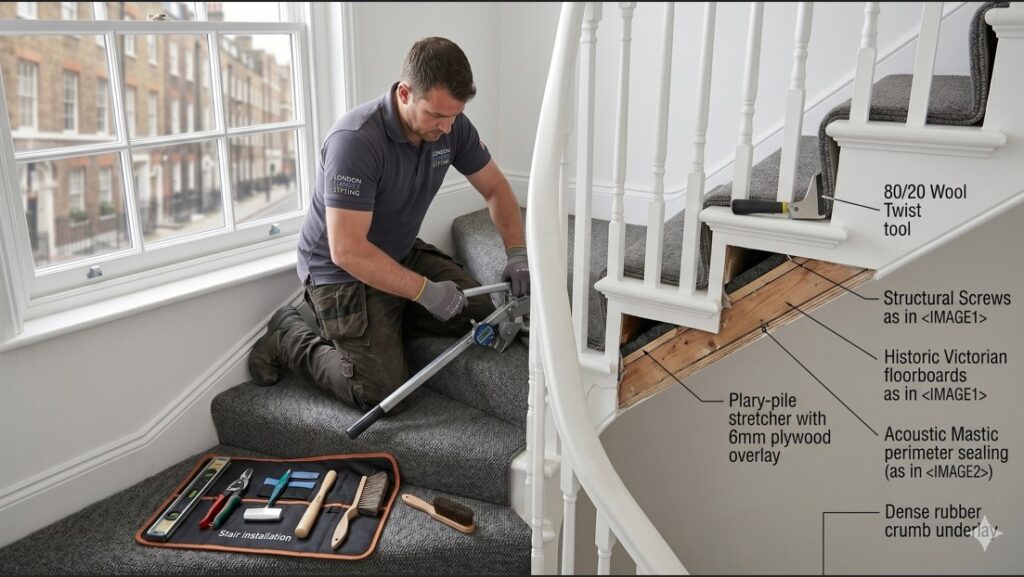
Loose boards are secured to the joists below using structural screws, not nails — screws provide sustained clamping force and do not “back out” over time the way nails do. In properties where joists have deflected or where multiple boards are affected, an overlay of 6mm or 9mm exterior-grade plywood is the professional standard. This plywood layer serves three functions simultaneously: it creates a true plane across the entire floor, it bridges over minor board movement, and it provides a consistent nail-holding base for gripper rods.
The plywood sheets must be laid in a staggered brick-bond pattern with a 2–3mm expansion gap between each sheet. Failure to do so creates straight-line joints that telegraph visibly through the carpet under certain lighting conditions.
For Concrete Subfloors:
Concrete floors require a different assessment protocol. The surface must be checked for:
- Adhesive residue from previous floor coverings (which must be mechanically removed, not covered over)
- Surface laitance — the weak, powdery top layer that forms during concrete curing, which must be ground back to a sound base
- Level variation exceeding 3mm under a 1.8-metre straight edge (the professional tolerance for carpet installation)
- Areas of rising damp or contamination
Where level variation exceeds tolerance, a floor-levelling compound is applied. The correct product selection matters significantly here: fast-setting compounds work well in occupied homes where disruption must be minimised, but they are more sensitive to subfloor moisture. In damp-prone areas, a moisture-tolerant formulation is the appropriate specification. The same subfloor discipline applies equally when clients opt for hard flooring installation — a poorly prepared surface beneath vinyl or LVT will telegraph imperfections just as readily as it does under carpet.
Step 2: Damp Proof Membrane Application
Rising damp in basement and lower ground floor flats is not a cosmetic problem — it is a structural threat to your flooring investment. Moisture migrating through a concrete slab will degrade underlay adhesion, cause carpet fibres to absorb odours, and create the warm, humid conditions that promote mould growth beneath the floor surface.
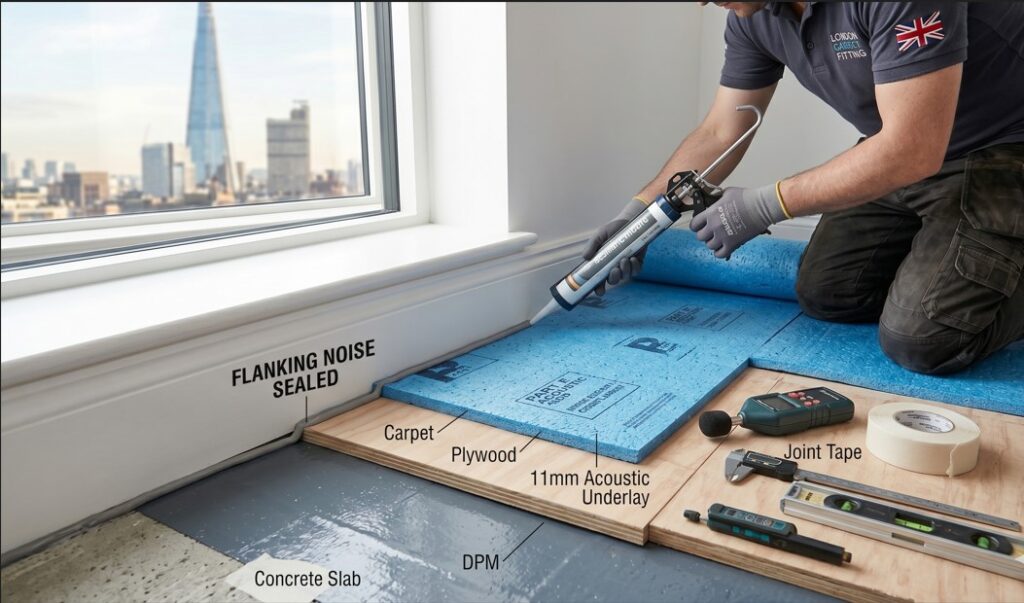
The professional solution is a liquid Damp Proof Membrane (DPM) applied in two full coats to the concrete slab before any other preparation work proceeds. Proper moisture testing using a calibrated hygrometer or a calcium chloride test should determine whether a DPM is required and what performance specification is necessary. A reading of above 75% relative humidity in the subfloor is the threshold at which a DPM is not optional — it is essential. If you are unsure whether your subfloor requires testing, the best starting point is a direct consultation with our technical team, who can advise based on your property type before any commitment is made.
Acoustic Compliance — London’s Most Overlooked Obligation
What Approved Document E Actually Requires
This is the section that separates professional carpet fitters from those who are merely competent.
Approved Document E (Part E) of the UK Building Regulations sets out legally enforceable standards for sound insulation between adjoining dwellings. If your property is a converted flat — any house that has been subdivided into multiple self-contained units — Part E applies to you. The relevant performance target for separating floors between dwellings is a maximum impact sound transmission level of L’nT,w ≤ 62 dB as measured in the field.
This is not a guideline. Building Control is scrutinising acoustic performance with increasing rigour in 2025, and Pre-Completion Tests are now required before final sign-off on new builds, extensions, and material changes of use. Acoustic failures discovered at this stage can cost between £5,000 and £15,000 per dwelling to remediate.
How Underlay Specification Determines Compliance
Standard carpet underlay — the 8mm foam product widely offered by volume retailers — provides useful comfort underfoot but contributes relatively little to Part E compliance in isolation. Professional acoustic underlay is a distinct product category, specified by its Delta Lw rating (the improvement it delivers over a bare floor) rather than simply its thickness.
For separated floors in converted flats, the appropriate specification is typically a high-density rubber crumb or PU foam underlay of 10mm to 11mm thickness with a Delta Lw performance of 35–45 dB. This underlay must be installed with acoustic perimeter detailing: the underlay is turned up the wall by 50mm before the skirting board is fitted, preventing the direct structural contact that creates “flanking paths” — secondary transmission routes that can reduce field acoustic performance by 10 dB or more.
Equally important is the perimeter sealing of the carpet itself. Where acoustic performance is a requirement, a professional sealant application at the junction between carpet edge and wall prevents airborne sound from bypassing the floor system through gaps at the perimeter — a detail that virtually no volume contractor addresses.
A Critical Point on Underfloor Heating:
If your property has underfloor heating beneath a concrete slab, carpet and underlay selection requires specialist attention. High-tog underlays act as thermal insulation, reducing the efficiency of the heating system and potentially causing the floor to overheat. For UFH applications, a combined carpet and underlay tog rating of 2.5 or below is the standard recommendation. Your fitter should be asking about your heating system before specifying underlay — if they are not, it is a reliable indicator of insufficient technical knowledge. Our full FAQ addresses underfloor heating compatibility in detail for those seeking further technical clarification.
Carpet Selection by Room Type — The London Context
Living Rooms and Master Bedrooms
For principal rooms in London homes — particularly Victorian properties where rooms are generously proportioned — an 80/20 wool twist is the professional first choice. The 80% wool component provides natural fibre resilience, allowing the pile to recover from furniture indentation and foot traffic. The 20% nylon adds tensile strength at the fibre tip, preventing the “balling” and shedding that pure wool carpets can exhibit under heavy use. Twist pile construction — where the yarn is twisted tightly before tufting — delivers a more durable finish than cut pile in high-traffic configurations.
Budget range to expect: £25–£55 per square metre for quality 80/20 wool twist, excluding underlay and fitting. For a detailed breakdown of all associated costs, our London carpet fitting pricing page provides transparent, current figures including subfloor preparation, acoustic underlay, and ULEZ-inclusive logistics.
Stairs and Hallways
Stairs impose a specific mechanical stress on carpet that is not replicated in any other room: the pivot-point pressure at the front edge of each tread. This is where the carpet is bent sharply over the nosing of the step and subjected to repetitive contact pressure every time someone uses the staircase. Budget synthetic carpets fail at this point first, developing a worn stripe across each tread that is impossible to remedy without full replacement.
The correct specification for London townhouse stairs is a mid-to-high weight 80/20 wool twist in a 50oz or above pile weight, fitted using the waterfall method on contemporary stairs or the cap-and-band method on traditional turned staircases where the tread nosing profile requires carpet to be drawn tightly over the edge. If your stair carpet has already developed wear at the nosing or visible fraying at the edges, our carpet repair service may allow you to extend the life of the existing installation before a full replacement becomes necessary.
Accidental Damage: Burns, Snags, and Pet Damage
A separate but common scenario in London rental properties and family homes is localised carpet damage that does not warrant full replacement. Cigarette burns, iron marks, pet clawing, and furniture snag damage are all repairable by a skilled technician. Our carpet burn repair service specifically addresses heat-related damage — restoring the affected area to a level indistinguishable from the surrounding pile in most cases, at a fraction of the cost of re-carpeting.
Rental Properties and Landlord Investments
Durability and ease of replacement are the governing criteria for rental stock. A commercial-grade nylon or polypropylene loop pile carpet in a neutral tone (mid-grey, warm beige) will withstand tenant occupation better than a cut pile product, is easier to spot clean between tenancies, and presents a professional appearance that photographs well for listings. Spend appropriately on underlay — a quality underlay extends carpet life significantly and protects the subfloor from the daily impact of foot traffic.
For landlords managing multiple properties or commercial spaces, our full range of flooring services — including commercial carpet tile installation available in evening and weekend slots — is designed to minimise disruption to tenants and business operations alike.
The Professional Installation Standard
Power Stretching vs. Knee Kicking — Why It Matters
The single most important technical decision in carpet installation is the method of tensioning. The majority of volume fitters use a knee kicker — a handled tool that the fitter drives forward with their knee to push the carpet over the gripper rods. This method is appropriate for small areas such as cupboards and box rooms, but it is categorically insufficient for the lounge, bedroom, or hallway of any London property.
A knee kicker cannot apply consistent tension across the width of a large room. The result is a carpet that appears flat immediately after installation but develops ripples, bubbles, and peaks within 12 to 24 months as the carpet relaxes under foot traffic. At that point, the carpet must be professionally re-stretched — at additional cost — or replaced. Our carpet fitting service exclusively uses industrial power stretchers on all installations above small room size, and all workmanship is backed by a warranty: if rippling occurs due to installation technique, we return and rectify at no charge.
Ask any prospective fitter directly: do you power stretch or knee kick? The answer will tell you everything you need to know about the quality of fit you are about to receive.
Gripper Rods and Perimeter Fixing
Standard lightweight timber gripper rods are acceptable for straightforward domestic situations. For London properties where the subfloor is concrete, or where the perimeter meets a tile or hard floor at a doorway, heavy-duty dual-purpose zinc-pinned grippers are the correct specification. These grippers have pins on both faces — one side for the subfloor, one for the carpet backing — and provide a far more secure hold in demanding conditions.
At doorways, the transition between carpet and an adjacent hard floor should be managed with a bespoke low-profile threshold bar, colour-matched to the adjacent surface where possible. Our service includes premium brass, bronze, and oak threshold options as standard replacements for the generic silver aluminium bars used by volume contractors. Where a hard floor adjoins the carpet — LVT, laminate, or stone — the same precision applies to the hard surface side; further detail on this is covered on our LVT and laminate flooring page.
The Comparison: Standard Contractor vs. Professional Standard
| Element | Volume Contractor Approach | Professional London Standard |
|---|---|---|
| Tensioning | Knee kicker | Industrial power stretcher |
| Gripper specification | Lightweight timber | Heavy-duty zinc-pinned dual-purpose |
| Acoustic underlay | Standard comfort foam | High-density rubber/PU, 35–45 dB Delta Lw |
| Perimeter detailing | Cut and tuck | Acoustic mastic sealant |
| Doorway transitions | Generic metal Z-bar | Bespoke colour-matched low-profile profile |
| Subfloor prep | Visual check | Hygrometer testing, DPM, plywood overlay |
| Damp assessment | None | Moisture test, liquid DPM where indicated |
| Warranty | None or verbal | Written workmanship guarantee |
London-Specific Logistics
ULEZ, Congestion, and Fixed-Price Quoting
The ULEZ zone now encompasses the entirety of Greater London. Any contractor operating non-compliant vehicles is absorbing a daily £12.50 surcharge that will either erode their margins or appear as a line item on your invoice. Our fleet is fully Euro 6 ULEZ compliant, and all congestion zone, ULEZ, and parking costs are included in every fixed quote — with no additional charges raised on fitting day. You can verify this commitment and review our pricing structure in full on our transparent pricing page.
Parking is the second logistical variable that catches homeowners by surprise. Permit-only zones across Islington, Hackney, and much of Zone 2 require advance application for contractor parking dispensations. Red route restrictions on major roads through the City of London and Westminster create additional complexity for any delivery of carpet rolls. We manage these logistics as part of every booking — to discuss access arrangements specific to your postcode before the fitting date, get in touch with our team directly.
Carpet Fitting Cost Benchmarks for London (2025)
Understanding what the market charges is essential context for evaluating any quote. Based on current industry data and our own published pricing, these are the realistic ranges for London:
- Fitting only (carpet supplied by client): £3–£6 per m² for labour; minimum half-day charge applies
- Acoustic underlay supply and installation: £2–£5 per m²
- Standard bedroom all-in (12–15 m²): £150–£300 including basic underlay
- Subfloor preparation (ply-boarding, DPM, levelling compound): £4–£8 per m²
- Stair fitting: £8–£15 per tread for straight flights; higher for turned staircases or bullnose profiles
- Commercial carpet tiles: £4–£7 per m² with evening and weekend slots available
Saturday fitting commands a 50% premium; Sunday and bank holiday work is typically charged at double the weekday rate. These premiums are legitimate and should be factored into your planning timeline. All figures quoted are inclusive of ULEZ and congestion charges.
How to Verify Your Carpet Fitter’s Credentials
The Questions to Ask Before Booking
The carpet fitting trade in London ranges from sole-trader craftsmen with decades of experience to unqualified labourers who have learned the basics from a YouTube tutorial. The market does not always make this distinction obvious. These questions will help you distinguish between them:
1. Are you a member of the National Institute of Carpet and Floorlayers (NICF)? NICF membership requires demonstrable technical competence and is the closest thing to a professional qualification in the trade. It is not mandatory, but its absence in a contractor who positions themselves as premium should prompt further questioning.
2. Do you carry public liability insurance, and at what level of indemnity? Any professional contractor working in domestic properties should hold a minimum of £1m public liability insurance. Ask to see the certificate, not just a verbal confirmation.
3. Do you power stretch or knee kick on large rooms? The correct answer is power stretcher. Any other answer for a room larger than 12 square metres should be a disqualifying response.
4. Do you conduct moisture testing before fitting on concrete subfloors? If you are in a flat with a concrete subfloor and the fitter does not raise this question themselves, raise it yourself. A fitter who fits over an untested concrete slab is exposing you to significant financial risk.
5. Can you provide a Part E-compliant acoustic specification for my property? If you are in a converted flat and the fitter cannot engage substantively with this question, they are not the right contractor for your property. Our frequently asked questions page addresses acoustic specification, BS 5325 compliance, and underfloor heating compatibility in detail — a useful reference point when comparing contractors.
6. Do you offer a written workmanship warranty? A verbal promise is not a warranty. Ask for confirmation in writing of what is covered and for how long. Our installations carry a written workmanship guarantee: if carpet rippling or seam failure results from our installation technique, we return and rectify at no additional cost.
If you want to understand more about who we are and how we operate before making a booking, our about us page provides background on our team, our standards, and our approach to London property fitting.
Frequently Asked Questions
How long should I wait after screeding before fitting carpet?
The standard rule of thumb is one day of drying time per millimetre of screed thickness, but this is a minimum under ideal conditions. London’s climate — particularly in converted basements and north-facing rooms — adds material humidity that extends drying times. Always verify with a calibrated hygrometer before fitting. A reading of 75% relative humidity or above requires further drying time or DPM application. Fitting too early results in adhesive failure, carpet rippling, and in severe cases, mould growth beneath the floor. Further technical questions of this nature are covered in our carpet fitting FAQ.
What is the best carpet for a Victorian staircase in London?
An 80/20 wool twist at a pile weight of 50oz or above, fitted with the correct tension method for the stair profile. The nosing detail is the critical point: the carpet must be drawn tightly over the front edge of each tread and secured firmly on the riser below to prevent the loose material that causes both rapid wear and a trip hazard. Runner carpets on traditional staircases can be fitted with carpet rods for a period-appropriate aesthetic that also allows the stair carpet to be shifted periodically, distributing wear. If your existing stair carpet has already developed worn nosing areas, our carpet repair service may extend its life before a full replacement is required.
Do I need to inform my freeholder or management company before fitting carpet?
In leasehold flats — the majority of London flat ownership — your lease will almost certainly contain provisions regarding floor coverings. Many leases in converted properties require carpet (rather than hard floor) to be maintained in living areas as a noise control measure. Some leases require prior consent for any change of floor covering. Check your lease terms and, where in doubt, write to your managing agent before committing to a fitting date. If you are considering switching from carpet to a hard floor such as LVT or laminate, note that this typically requires explicit freeholder consent and may necessitate acoustic underlayment that the lease specifies — a consideration covered in detail on our LVT and laminate flooring page.
Can I use underfloor heating with carpet?
Yes, but specification matters. The combined tog rating of the carpet and underlay must not exceed 2.5 in most UFH system specifications. Use a thin-profile felt underlay rather than thick PU foam, and choose a carpet with a shorter pile and open construction that allows heat to transfer through the floor system efficiently. Always confirm your specification with the UFH system manufacturer before proceeding. Our team assesses UFH compatibility at the survey stage for every relevant installation — contact us to arrange a free technical site visit.
What happens if my carpet develops ripples after fitting?
Rippling after installation is almost always the result of inadequate tensioning — specifically, a knee-kicked installation that has relaxed under use. A professional re-stretch using a power stretcher will typically resolve the issue without replacement. If the ripples appear within 12 months, this constitutes a fitting defect and the contractor should return to remedy the issue under warranty obligations at no charge to you. If your original fitter is unresponsive, our carpet repair and re-stretching service is available across all London boroughs.
Conclusion: The Cost of Getting It Right vs. Getting It Wrong
The average cost of a professional carpet installation for a three-bedroom Victorian terrace in London — including appropriate subfloor preparation, acoustic underlay, quality 80/20 wool carpet, and all the associated logistics — will run to several thousand pounds. It is a significant investment.
The cost of getting it wrong is higher. A failed acoustic inspection in a converted flat costs £5,000–£15,000 to remediate. A carpet fitted over damp concrete without a DPM will need replacing within two to three years. A knee-kicked carpet in a large lounge will require re-stretching within 12–24 months. And a stair carpet fitted without proper tensioning and nosing detail will wear through in the high-stress areas within a fraction of its designed lifespan.
The difference between a professional fit and an adequate one is not always visible on the day of installation. It becomes visible over time — in the flatness of the floor, the integrity of the acoustic environment, and the longevity of the investment.
Choose your fitter on the basis of technical competence, verifiable credentials, and a willingness to engage with the specific challenges of your property. London’s housing stock demands nothing less.
Ready to discuss your project? Request a free technical site survey — our team will assess your subfloor, confirm your acoustic obligations, and provide a fixed-price specification with no obligation. Alternatively, review our transparent pricing or browse our full range of services before getting in touch.
📞 07578196079 | ✉ info@londoncarpetfitting.co.uk